Author: John M. Fredericks

  • It Must Be What You Think It Is

    It Must Be What You Think It Is

    This is a story I left out of Naked Parrot. I wrote it in my twenties, while I was imitating David Foster Wallace and experimenting with form, and after it I explain why it didn’t make the book.

    It Must Be What You Think It Is

    Roswell, GA. December 14th, 2007.

    “So, then, it’s a bad thing. What you’re saying is it’s a bad thing?”

    “No. It can’t be a bad thing. If it was a bad thing, I wouldn’t do it. It must be a good thing. It makes me feel good, which makes it a good thing.”

    “But then like afterwards you feel bad. That’s what you’re telling me.”

    “Right but that doesn’t make it inherently a bad thing.”

    “There are aspects that are bad and there are aspects that are good.”

    “I’m thinking.” He pauses. “That was a pause, to signal that I’m thinking because you raise a good point. It’s not a great point. Not a stumper. Just a good one. A point with legs, so to speak. Figuratively. Speaking, that is. It’s an angle I haven’t considered. But it’s not the conclusion I’m driving at. It’s not exactly what I’m saying because while, sure, there are some good qualities about it—i.e., for example, how it feels good and provides like a little escape from the day and the wife and those quarrelsome kids—there are also a few bad qualities. Like, again, for example, how it’s like mega, uber-addictive in sneaky ways that I never thought it could—or would—be. It’s not like drugs where you know what you’re getting into. Or alcohol, which is slower, definitely, but just because it’s slower doesn’t mean it’s not addictive and we know it’s addictive because we know someone who doesn’t drink. You see Randy at a party or eating sushi with his wife and you think: Oh, well, there goes Randy. He doesn’t drink because he got hit with a few DUI’s and once took his pants off at Lisa’s and embarrassed his first wife, who, of course, left him because he drank too much and lost his job et cetera, et cetera. But this? Well, this is addictive in a highly sneaky, very subconscious kind of way.

    “Porn.”

    “Porn.”

    “Internet porn?”

    “Internet porn, sure. Yeah, mostly internet porn. But all types, really. There’s all kinds of porn. It traverses every medium. It’s in magazines and on old videotapes and in novels about women and men. It’s even on the radio.”

    “The radio?”

    “Right, yeah. Definitely, it’s on the radio. People go on the radio and they hop on these little machines and orgasm all over the place and overweight guys like me listen in and get hard listening in and then they call into the show and say, Wooooo Doggy, into the receiver and the shock jock hoots and hollers and everybody has a great time and these girls huff and puff until the shock jock brings the next girl on the show the next week to hop on an even bigger machine with more like gusto or compute or glam-o-rama and the girl goes orgasmo everywhere.”

    “Do these machines have a name?”

    “They call it The Floppy 5000.”

    “So, you’re addicted to radio porn.”

    “And that’s what I’m saying. I’m sitting here. I’m facing you in your living room on this brisk December night while your wife’s in the shower and I’m saying I need help, like I need a radio porn intervention.”

    “Please don’t talk about my wife.”

    “So it has all of these characteristics of the more socially acceptable like addictions and whatnot: it’s a bad thing that feels good, it’s sneaky in its addictive power, and it’s everywhere. The radio never stops. The radio is 24/7. But that doesn’t make it socially okay. Like a socially normal thing. You can’t go up to somebody and say: Hi, I’m John Jacobs. I’m addicted to terrestrial radio pornography. I couldn’t go up to your wife and say that. That would be crazy. She would slap me. I mean, she wouldn’t slap me because she knows me and knows how kind I am and how I would never hurt a fly, which is just an expression because of course I would hurt a fly, but that’s not really the point.”

    “Let’s leave my wife out of it.”

    The centralized heating cranks on and the two men shift one way, then another. Warm air pumps through the living room.

    “What I’m saying is that I need an intervention. I want you guys—you and your wife and whoever else you think should come—but definitely your wife, to like throw me an intervention because I’m addicted, Duane. I’m addicted to radio porn and I diddle my giblets all the time and I can’t even sleep because the radio doesn’t sleep. I just sit in my basement and listen to beautiful women do grotesque things to The Floppy 5000 and I listen to the radio shock jock who grunts and groans and talks about her hoo-hahs and sometimes pontificates on how 9/11 was a hoax. So I’m thinking if you got some friends together and like one of those counselors we could have an intervention and that would be pretty good for me. My wife could come, even.”

    “Isn’t it supposed to be a surprise? The intervention? I don’t think you’re supposed to know about it.”

    “You’re right. Forget I said anything about your wife.”


    Why I left this out of Naked Parrot

    “It Must Be What You Think It Is” almost made it into the second edition of Naked Parrot. The first edition was much more serious and took on a lot of heavy themes. For the second edition, I took most of those out and replaced them with humor, which is what I prefer to write anyhow. “It Must Be What You Think It Is” made the shortlist because it’s funny, but that’s about it.

    I wrote it in my twenties, when I was reading a lot of David Foster Wallace: Brief Interviews with Hideous Men, Infinite Jest, and his essays. At some point I decided to imitate him, and this is what came out. The tone is his, the language is his, and so is the content, really. The narrator comments on his own pauses. He stacks qualifiers until the sentence loses track of where it was going: “so to speak. Figuratively. Speaking, that is.” He says “i.e., for example.” The jokes are all in the digressions, and nothing much happens. These are many of the reasons I loved reading DFW.

    Most of Naked Parrot pays close attention to physical things: the way a hand holds a tomato, a faded stain at the bottom of a bowl, fingerprints on the stem of a wine glass. Feeling rides on the objects, and the sentence moves on. Even the loud pieces, like “The Manifesto,” are built out of images. This story is almost all talk. The only physical thing in it is a heater.

    The bigger problem is that it doesn’t say anything interesting. Most of the pieces in Naked Parrot have something to say about the themes I keep coming back to: family, substance abuse, technology, the South. This one is about addiction, and, in a way about technology, but it doesn’t say anything new or interesting about addiction or about our addiction to technology. I also wanted it to be fragmentary, but when I revised it, I didn’t think it had communicated much of anything, aside from being funny.

    And I’m not sure it’s even that funny. It feels immature to me now, like a joke you’d tell in your early twenties. I’ve said before that I like some of the writing in this book precisely because it isn’t any good, so the book is uneven on purpose. But uneven isn’t the same as empty. Most of what made it in is saying something in a voice I recognize as mine.

    Naked Parrot is out now in paperback, hardcover and Kindle.
  • The Manifesto: the poem that opens Naked Parrot

    The Manifesto: the poem that opens Naked Parrot

    The first thing you read in Naked Parrot, before Part 1 and before the dedication, is a poem called The Manifesto. Here it is.

    I want my poems to be bloody,
    dangerous like raw chicken,
    chaotic, full of errors/errorful—
    there’s a certain celebration in
    contractions and deviations
    and unnecessary articles/images
    that depart like a sunken vessel
    from the craft of Good Poetry—
    antiseptic rhyme organized by line,
    so I can maybe develop my
    Poetics of Sin, because I’ll
    tell you this: my poems
    get worse with revision—
    I don’t want to be anthologized
    or studied or employed at
    the University/professional
    hell and I sure as shit
    don’t want to talk to a room
    of you about any of this,
    like a fraudster—instead why
    don’t we just settle in,
    skim the milk for the frothy
    glue of a good line turned
    sideways and just for once
    in our lives let these poems
    fucking be.

    Why start here?

    A manifesto is supposed to be a list of demands. This one is mostly a list of things I don’t want, and it gets pretty specific by the time it reaches the University/professional hell. It’s basically a warning label. If you get to “raw chicken” and hate it, you probably have your answer about the next two hundred pages.

    For the record, I hate it too. I left “dangerous like raw chicken” in there precisely because I don’t like it.

    What’s a Poetics of Sin?

    Raw chicken isn’t the only thing I left in on purpose. In my last post I mentioned the typos. This is the poem that explains why, or at least the poem that makes it sound like a principle instead of laziness (it might just be laziness): “my poems / get worse with revision.” I believe that about some of them. Others I revised for years. 

    Look at the slashes, too: “errors/errorful,” “articles/images,” “University/professional.” If you read the last post, you’ve seen me capitalize things when I’m making fun of them, like Real Book and Serious Writer. Good Poetry gets the same treatment here, and so does the University.

    Who’s the fraudster?

    “I sure as shit / don’t want to talk to a room / of you about any of this, / like a fraudster.” 

    I spent eight years teaching at the University of Nevada, Reno, and five more at West Tallahatchie High School in Mississippi. That’s a lot of rooms and a lot of poems. I know how it goes: you take something that hit you in the gut and you explain it until it’s a worksheet. The poem doesn’t trust that job much, and I’m the guy who did it for thirteen years.

    Can we just let these poems be?

    If I could only keep one part of it, it’d be the ending: “just for once / in our lives let these poems / fucking be.”


    The Manifesto opens Naked Parrot, out now in paperback, hardcover and Kindle. Read more about the book, buy it on Amazon, or read Why I self-published Naked Parrot.
  • Why I self-published Naked Parrot

    Why I self-published Naked Parrot

    I’ve been working on being more vulnerable with my writing, getting comfortable with the imperfections, throwing a book together that doesn’t make much sense. I like the messiness of it, the process. But a traditional publication route would not have given me these opportunities. This is a long way of saying Naked Parrot, as it stands today, would never find a home in a traditional publishing house. I designed the book with that in mind, resisting a cleaner manuscript. This writing is not workshop approved. 

    Some of the stories and poems in Naked Parrot I revised meticulously, over years and years, starting from when I was about twenty-one. Others I wrote on my phone while sitting on the toilet or riding in a Waymo. Those went into the book more or less the way they came out. I left some spelling errors and typos in on purpose, just to show the process.

    Publish or perish?

    I never sent this book to an agent or a publisher. In my twenties I tried hard to make it as a writer, and a lot of these pieces come from that stretch. If you happen on a more serious story, one with Big Themes and even Bigger Words, it more than likely came from a period in time when I thought there would be nothing as cool as publishing a Real Book. Some of the more playful pieces, the pieces with more expansive prose, and most of the poetry, came from a more mature place in my life, usually written in my mid-thirties, when I stopped tying my identity to Becoming a Writer, and started just not really giving a fuck. The book takes readers through that.

    So, I turned to self-publishing. I find that self-publishing lets my work be messy, devolving into tangents and fragments with no real center to hold them together.

    This book is not cohesive, and I don’t think I could pitch it in one sentence. The quality goes up and down, but I like some of the writing in there precisely because it isn’t any good. I don’t want to be a Serious Writer with Big Ideas about the World. You’ll find quite a bit of levity here because of that.

    Think about Naked Parrot as a mosaic, a long, disjointed string of tiles piecing together my life. Fragmentation is how I interact with the world.

    What am I searching for?

    A publisher would have wanted to take eight to ten stories, or a series of poems, and tie them together neatly into a book with one Major Theme and a Clear Voice. That’s a fine idea — one I dreamed of writing for most of my life. It just isn’t this book.

    Self-publishing let me hand the reader the whole pile and say: this is me, look. Even the drawings are felt-tip doodles I made during the pandemic, and I’m pretty bad at drawing, although scanning them into the computer fixed a lot of that for me. The computer is our friend now, I guess.

    It took me 20 years to get to this point, but the publishing part was cheap. Amazon makes the process basically free, and who doesn’t want to design a book cover?

    Should you self-publish?

    If you’re thinking about self-publishing, do it, but take your time with the manuscript. Read the book a few times before you publish. You’ll catch little things you want to change, typos you may (or may not) want to fix. I already put out a second edition, because I re-read the first edition and hated it. In the age of AI, it’s seductive to have something like this just produced by a machine, but sit with it before you publish. Or let AI do everything for you. I don’t care!


    Naked Parrot is out now in paperback, hardcover and Kindle. Read more about the book, buy it on Amazon, or read What is a Naked Parrot?
  • What is a Naked Parrot?

    What is a Naked Parrot?

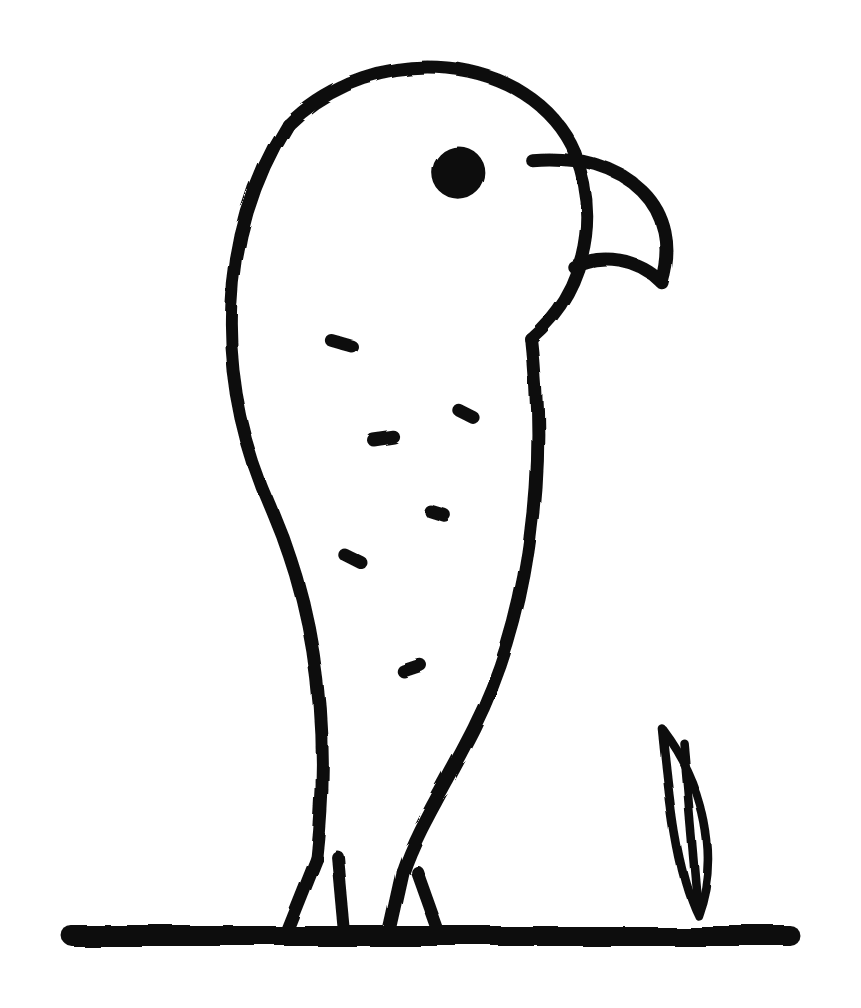
    A naked parrot is a parrot that plucks all of its feathers out, as a way to sort of die by suicide. They do it when they get depressed. It’s an odd behavior, and it’s where my book gets its name. Read more: What is a Naked Parrot?

    Feather Destructive Behavior

    Vets call it feather destructive behavior. It shows up in pet birds, most of all in the big, smart species that bond tightly with their owners: cockatoos, macaws, African grays. The first thing a vet does is rule out a medical cause, because infections, parasites, liver and kidney disease, and a bad diet can all make a bird go after its own feathers (VCA Animal Hospitals). When nothing medical turns up, the usual cause is stress. A new cage, a new person in the house, too many birds in one space.

    A 2009 review in Applied Animal Behaviour Science explains how stress turns into plucking (van Zeeland and colleagues). A stressed parrot preens. Under constant stress the preening doesn’t shut off, and the bird starts pulling feathers out. The researchers link it to the bird’s stress hormones and brain chemistry, including serotonin and dopamine, and they say it has a lot in common with trichotillomania, the disorder where people pull out their own hair.

    So a vet wouldn’t say the bird wants to die. Preening is supposed to take care of the bird, and it ends up being what hurts it.

    Eating Disorders

    That’s why I’ve always thought a naked parrot was a useful metaphor for people with eating disorders. A lot of them are girls and women, but not all of them. Eating is supposed to be a celebratory act, a way to gain sustenance, a modern human marvel. Yet, with an eating disorder, it becomes the thing that’s hurting you, and like the bird, a lot of people can’t stop.

    The title poem is probably the strongest poem I’ve ever written, though I think it’s kind of weak at the end. It’s in Naked Parrot: Poems and Stories, which is out now.

    If you or someone you know is struggling with an eating disorder, the National Alliance for Eating Disorders runs a free helpline staffed by licensed therapists: 866-662-1235.